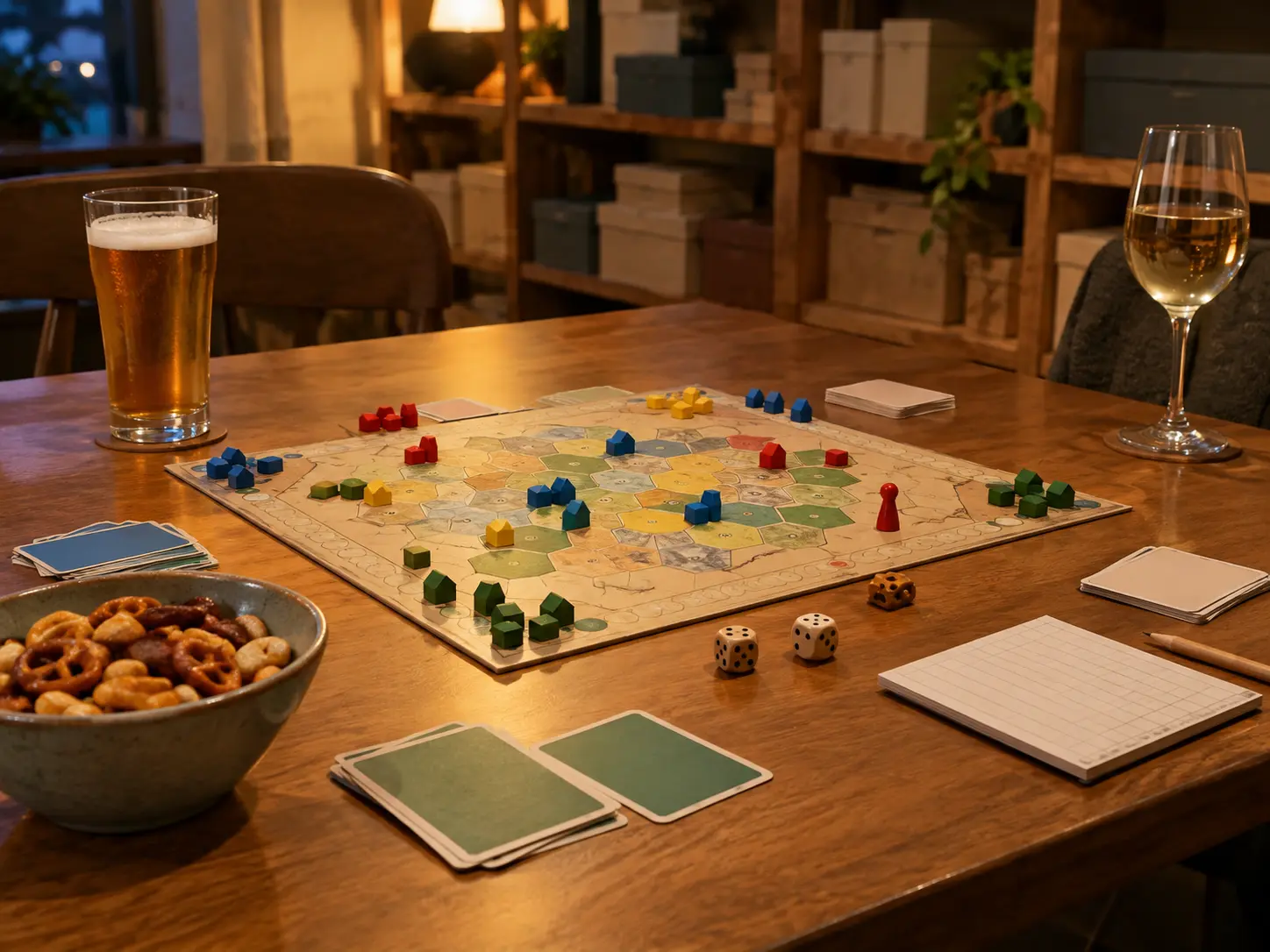
The short answer: to host a board game night for people who don’t know each other, book a table at a board-game café or a quiet pub for six to twelve people, pick two or three easy games that teach in five minutes (party, word and cooperative games work best), and send an invite with the time, place, seats and who pays. Remind people two days before, arrive early to set up, start with a short, silly game, split into tables of three to five, and finish on time with the date of the next one. This playbook gives you the full timeline and copy-paste templates.
Games nights are one of the easiest ways to bring strangers together. The game gives everyone something to do with their hands, fills any silences and creates instant in-jokes. Your job as host is simply to remove the friction: the right venue, the right games and a warm welcome.
Where to host: café, pub or home?
| Venue | Pros | Cons | Best for |
|---|---|---|---|
| Board-game café | Huge library of games, staff who can teach, food and drink sorted | Often a per-person table or cover fee; book ahead at weekends | First nights with strangers |
| Pub with a quiet room or corner | Familiar, central, no entry fee in most | Noise, small tables, you bring the games | Regular, relaxed groups |
| Community centre or library room | Big tables, quiet, sometimes cheap or free to book | No bar; you may need to bring snacks | Larger or alcohol-free groups |
| Someone’s home | Cosy and free | Not right for people meeting for the first time | Later, once the group knows each other |
For a group of people who haven’t met, always start somewhere public. A board-game café is the easiest first option, because the staff can help with rules and the venue has done half your hosting for you. Check the café’s own website for prices, opening times and booking rules, as these vary widely.
How many people should you invite?
Six to twelve is ideal for a first night. That gives you two or three tables of three to five players, which is the sweet spot for most social games. With fewer than six, one cancellation can derail the evening. With more than twelve, it becomes hard to mix people and teach rules. If you’re starting a regular group, cap the first one at eight and grow from there.
Choosing games for a group of strangers
Pick games that are quick to explain, keep everyone involved on every turn and create laughter rather than intense silence. Avoid long, rules-heavy strategy games for a first night; they’re brilliant once a group knows each other.
| Game type | Why it works with strangers | Examples |
|---|---|---|
| Word and party games | Played in teams, lots of chat and laughs, easy to join mid-way | Codenames, Just One, Wavelength |
| Light card games | Teach in minutes, play in 15–20, easy to repeat | Sushi Go!, Love Letter |
| Cooperative games | Everyone wins or loses together, so no one feels singled out | Forbidden Island, The Mind |
| Gateway strategy games | Simple rules, a little more thinking, good second game | Ticket to Ride, Carcassonne |
| Drawing and guessing games | Silly, creative and great icebreakers | Telestrations, Pictionary |
Check the box for the player count and play time before you choose, so you can match each game to the size of each table. Social deduction games (where players lie and accuse each other) can be great fun, but they work better once people are comfortable together.
A simple running order
- Warm-up (15 minutes): a quick party or drawing game while people arrive, open to anyone who walks in.
- Main game (45–60 minutes): split into tables of three to five, each with a game that suits its size.
- Break: drinks, snacks and a chance to swap tables.
- Second game (30–45 minutes): a different style, so people who preferred the first type get a turn at something new.
- Finale: one big team game for everyone, then announce the next date.

The timeline: two weeks out to the follow-up
Two weeks out: book and invite
- Book the table or room for your planned number, and ask about any fees, deposits, time limits or minimum spends.
- Choose two or three games (or check the café has them).
- Decide who pays and say so up front: everyone pays their own entry and drinks, split a shared fee, or the host covers it. One clear line in the invite avoids awkwardness.
- Send the invite with every detail in one message (template below).
One week out: confirm and prepare
- Confirm who’s coming and keep a short reserve list.
- Set up a group chat for confirmed guests so people can say hello before they meet.
- Learn the rules of your first game properly. Watch a short how-to-play video if it helps.
- Ask about accessibility or dietary needs if food is involved.
Two days out: remind
- Send a friendly reminder with the time, the address and how to find your table.
- Ask anyone who can’t make it to say so, so you can offer their seat to someone on the reserve list.
On the day
- Arrive 20 minutes early to set out the first game and grab a sign or spot people can recognise.
- Greet each guest, introduce them to someone already there, and seat them at the open game.
- Start a short warm-up game as soon as three or four people arrive. Latecomers can join the next round.
After: follow up
- Thank everyone in the group chat the next day.
- Share a photo of the final scoreboard (with permission) and announce the next date.
- Ask which game people enjoyed most, and plan the next night around it.
The host’s kit
If you’re not at a board-game café, a small kit saves a lot of fuss on the night:
- Your two or three chosen games, with all the pieces checked beforehand.
- Pens and paper for scoring (some games need them; most groups end up wanting them).
- Name stickers or a marker for first names, which really helps people who’ve just met.
- A printed or saved copy of the rules for each game, in case you forget a detail.
- A phone charger and the venue’s booking confirmation.
- Something to mark your table, such as a bright game box placed on top, so arrivals can find you.
Template: invite
Board games for new faces: Thursday 3 December
I’m hosting a relaxed board game night for people who’d like to meet someone new. No experience needed; I’ll teach every game.
When: Thursday 3 December, 7–9:30pm
Where: [Café or pub name], [street] (table booked under my name)
Seats: 10
Games: a quick party game to start, then Codenames and Ticket to Ride
Cost: everyone pays their own table fee and drinks
To join: reply by SundayLook for the table with the giant pile of boxes!
Template: reminder (two days before)
Hi all! Looking forward to Thursday: 7pm at [venue], table under [your name]. It’s about five minutes’ walk from the station. If you can’t make it any more, just let me know by tomorrow evening so I can offer your seat to someone on the waiting list. See you there!
Template: house rules (pin in the group chat)
- Beginners are welcome; nobody needs to know the rules beforehand.
- We play to have fun, not to win at all costs.
- Explain the rules to newcomers kindly, and don’t play other people’s turns for them.
- Phones away during games, please (photos of the board are fine).
- If you can’t come, let the group know at least 24 hours before.
- Be kind. The host may ask anyone who makes others uncomfortable not to come back.
How to teach rules in five minutes
- Start with the goal: “We’re trying to get our team to guess all our words before the other team.”
- Explain one turn: what you do, step by step.
- Show how the game ends and how you win.
- Skip the edge cases. Explain them when they come up.
- Play an open practice round with everyone’s cards visible.
If teaching isn’t your strength, ask a board-game café’s staff to explain, or invite a confident player to run one table while you run another.
Making strangers feel welcome
- Do quick introductions at each table: name and the last game you enjoyed (or “never played anything but Monopoly”, which always gets a laugh).
- Mix the tables after the first game, so people meet more of the group.
- Look out for anyone quiet and pair them with a warm, chatty player.
- Use a warm-up activity. Our list of icebreaker games for adults has a few that take two minutes and need no equipment.
- Make non-drinkers welcome. Pick a venue with good soft drinks and never comment on what anyone orders.
Many first-timers will have come on their own and be a little nervous. It’s worth sharing our guide to going to a meetup alone in your group chat for anyone who mentions it.

Handling no-shows and late cancellations
- Over-invite slightly. For ten seats, confirm ten and keep two or three on a reserve list.
- Remind people two days before and on the morning of.
- Choose flexible games that work across a range of player counts, so one missing person doesn’t break a table.
- Be clear about fees. If the venue charges for no-shows or holds a deposit, say so in the invite so people know a late cancellation matters.
- Don’t dwell on empty chairs. Merge tables and carry on.
Common mistakes (and easy fixes)
| Mistake | Fix |
|---|---|
| Choosing a long, complex game first | Start with a 15-minute party or card game |
| Everyone at one big table | Split into tables of three to five |
| Host stuck teaching all night | Pick games you know well, or recruit a co-host |
| Vague about cost | One clear line in the invite about who pays |
| Friends sitting together all evening | Mix tables after the first game |
| No next date | Announce it before people leave |
Turning one night into a regular group
- Pick a rhythm, such as the first Thursday of every month, and stick to it.
- Keep the same venue for a while so people know where to go.
- Save a couple of seats for newcomers each time.
- Rotate a “game of the month” chosen by a different member, and mix in an occasional outing from our list of group activities for adults.
- Find a co-host to share booking, welcoming and teaching.
The same principles apply to any recurring meetup. See our guide to organising a meetup for the general playbook, and our guide on how to host a group dinner if you’d like to add food to the mix.
Post your games night as a plan
A games night at a public café or pub, with a set time, a fixed number of seats and a clear answer on who pays, is exactly the kind of plan MeetNow, our own app, is built for (see our disclosure). People ask to join with a short note, the host picks who comes, and accepted guests get a group chat before the night.
Want to turn this into an actual plan? MeetNow is a free app for meeting people in person: a host posts a plan at a public place, says who pays (host pays, split, pay your own or free) and picks who joins. It is live on the web now, starting in Malta, with the phone apps on the way: open MeetNow and see the plans near you.
FAQ
How do you host a board game night for strangers?
Book a table at a board-game café or a quiet pub for six to twelve people, choose two or three easy games, send a clear invite with time, place, seats and cost, remind people two days before, start with a short party game and split into tables of three to five.
What are the best board games for a group of strangers?
Quick-to-teach party, word and cooperative games work best, such as Codenames, Just One or Forbidden Island, followed by a gateway game like Ticket to Ride once people have warmed up.
How many people do you need for a board game night?
Six to twelve is ideal for a first night: enough for two or three tables of three to five players, and enough that one cancellation doesn’t derail the evening.
Should a board game night be at home or in a café?
For people who haven’t met, start in a public place such as a board-game café, pub or community room. Home game nights work well once the group knows each other.
How do you stop people dropping out of a games night?
Send a clear invite, a reminder two days before and a short message on the day, ask for 24 hours’ notice of cancellations, and keep a reserve list so empty seats can be filled.