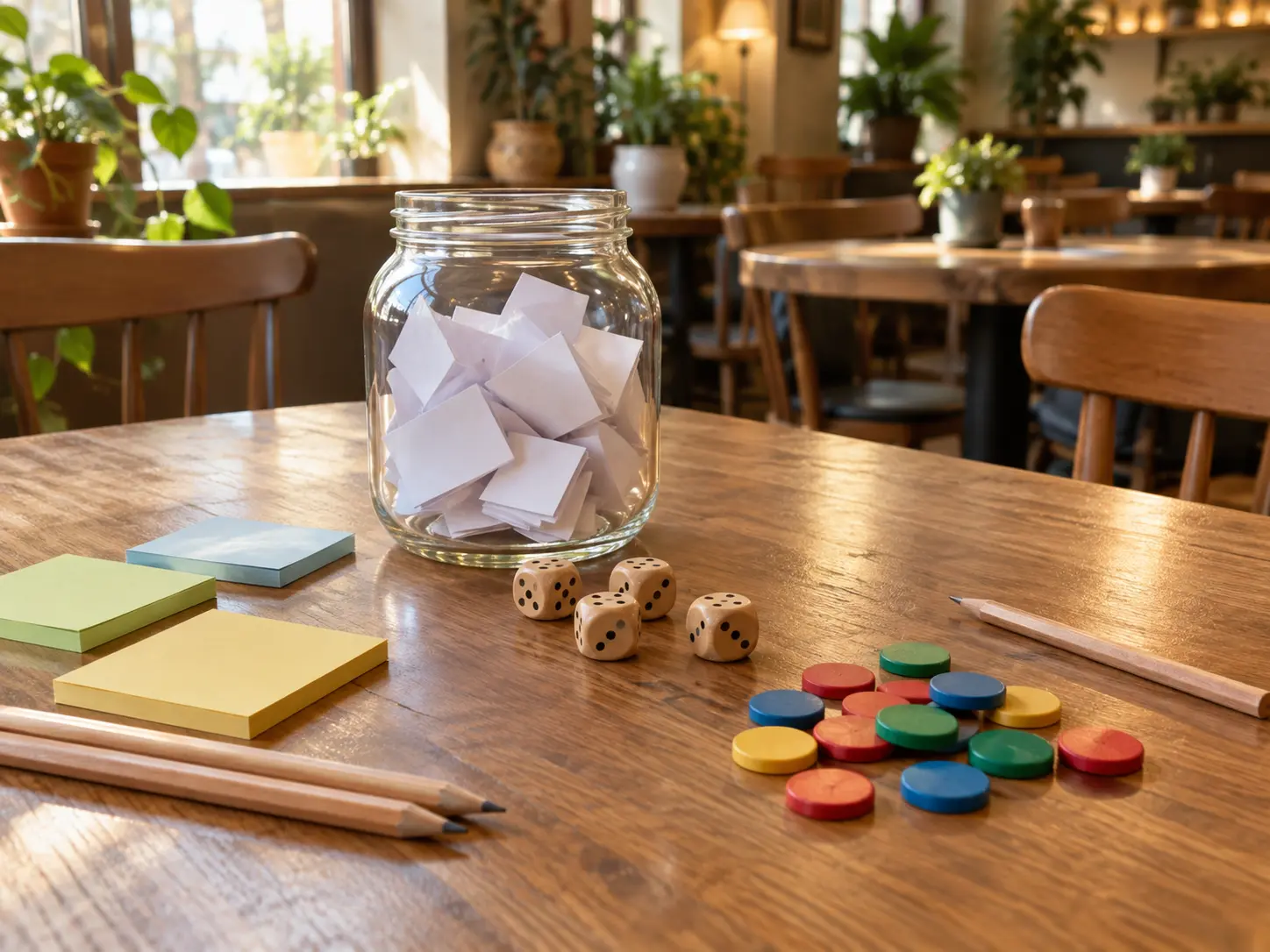
The short answer: the best icebreaker games for adults are short, optional and impossible to “fail”. Think Two Truths and a Lie, Would You Rather, Common Ground or a simple question jar, rather than anything involving trust falls or singing. Explain the game in one sentence, keep it under ten minutes, let people pass, and go first yourself. Below are 25 icebreaker games grouped by setting (around a table, on a walk, at dinner, on a board-game night, and for bigger groups), each with group size, time and an honest awkwardness rating, plus host tips for groups of strangers.
If you’re hosting a meetup where most people don’t know each other, an icebreaker can do in five minutes what small talk takes an hour to manage. The trick is choosing one that suits the group and the setting, and knowing when to skip it altogether. If games aren’t your style, our guide on how to start a conversation in a group has simple scripts instead.
How to run an icebreaker that isn’t cringe
- Make it opt-in. “Anyone up for a quick game while we wait for food?” works better than “Right, everyone’s doing this.”
- Explain it in one sentence. If a game needs a rules briefing, it’s too complicated for strangers.
- Go first. Your answer sets the tone. Make it light and a little self-deprecating.
- Keep it short. Five to ten minutes is plenty. Stop while people are still enjoying it.
- Always allow a pass. Nobody should have to share anything they don’t want to.
- Avoid physical contact, singing, performing and anything that singles one person out.
- Read the room. If conversation is already flowing, you don’t need an icebreaker at all.
Awkwardness ratings below: low (anyone can join in), medium (needs a slightly playful group), high (only for groups that are already warmed up).
No-props table games (any café or pub)
1. Two Truths and a Lie
Each person shares three statements about themselves, one of which is false, and the others guess the lie. Group: 3–10. Time: 10 min. Awkwardness: low. The classic for a reason: everyone learns something real about each other.
2. Would You Rather
Ask a light dilemma (“Would you rather give up coffee or chocolate for a year?”) and go round the table. Group: 2–12. Time: 5–10 min. Awkwardness: low. Prepare five questions in advance so you don’t stall.
3. Common Ground
In pairs or small groups, find three things you have in common that aren’t obvious (not “we both live in Leeds”). Share the strangest one. Group: 4–20. Time: 5–10 min. Awkwardness: low. Great for getting strangers talking one-to-one.
4. Highs and Lows
Everyone shares the best and the trickiest part of their week, in a sentence each. Group: 3–10. Time: 5–10 min. Awkwardness: low. Works well for recurring groups that meet weekly or monthly.
5. This or That
Rapid-fire choices: tea or coffee, beach or mountains, early bird or night owl, sweet or savoury. People answer instantly; follow up on the surprising ones. Group: 2–12. Time: 5 min. Awkwardness: low.
6. The Name Game (with a twist)
Say your name plus a food or place that starts with the same letter (“Priya, pizza”). The next person repeats the previous names before adding their own. Group: 5–12. Time: 5 min. Awkwardness: medium. Genuinely useful for remembering names.
7. Desert Island
Everyone names three things (one book, one album, one luxury) they’d take to a desert island, and why. Group: 3–10. Time: 10 min. Awkwardness: low. The “why” is where the conversation comes from.
8. Hot Takes
Each person shares a mild, harmless unpopular opinion (“pineapple belongs on pizza”, “summer is overrated”); others vote agree or disagree. Group: 3–12. Time: 5–10 min. Awkwardness: low to medium. Keep it to food, films and habits, never politics.

Games with simple props (paper, pens, sticky notes)
9. Fact in a Hat
Everyone writes a little-known fact about themselves on a slip of paper. Mix them up, read them out one at a time and guess who wrote each one. Group: 5–15. Time: 10–15 min. Awkwardness: low. Ask people to keep facts light.
10. Who Am I?
Write a famous person or character on a sticky note and stick it on someone’s back or forehead; they ask yes/no questions to work out who they are. Group: 4–15. Time: 10–15 min. Awkwardness: medium. Better for a games night than a dinner.
11. Question Jar
Bring a jar of folded questions (“What’s the best meal you’ve ever had?”). People take turns pulling one out and answering, or passing it on. Group: 3–12. Time: as long as you like. Awkwardness: low. Our conversation starters list and deep questions by stage are good sources for the slips.
12. Human Bingo
Hand out grids with prompts (“has lived abroad”, “can name three Irish rivers”, “has run a 5k”) and people mingle to find someone for each square. Group: 10–40. Time: 15 min. Awkwardness: low to medium. Ideal for larger groups standing up.
13. Draw Your Weekend
Everyone has one minute to sketch their ideal weekend; others guess what it shows. Group: 4–10. Time: 10 min. Awkwardness: medium. Bad drawing is part of the fun.
Walking and active icebreakers
14. Walk and Swap
On a group walk, pair people up for ten minutes with a question to discuss, then swap partners at a landmark. Group: 6–20. Time: whole walk. Awkwardness: low. Walking side by side makes talking to strangers much easier.
15. Photo Scavenger Hunt
Give small teams a list of things to photograph on the route (a red door, a dog in a coat, something older than 100 years). Group: 6–20. Time: 30–60 min. Awkwardness: low. Only photograph objects and places, not strangers.
16. Local Expert
As you pass places, anyone who knows a story about them shares it: a favourite café, a building with a history, a view worth knowing. Group: 4–15. Time: whole walk. Awkwardness: low. Works brilliantly for people new to a city.
17. Alphabet Walk
Spot something beginning with each letter of the alphabet as you walk, as a group. Group: 3–10. Time: 20–30 min. Awkwardness: low. Silly, low-pressure and surprisingly competitive.
Dinner-table icebreakers
18. Menu Stories
While choosing food, everyone shares the dish that reminds them of home or a trip. Group: 4–10. Time: 5–10 min. Awkwardness: low. Natural, because you’re already looking at the menu.
19. Pass the Question
Each person asks the person on their left one question from a set list, then the next person continues. Group: 4–10. Time: 10–15 min. Awkwardness: low. Ensures quieter people get airtime.
20. Best and Worst Recommendation
Everyone shares the best thing they’ve watched, read or eaten lately, and one thing they’d warn others off. Group: 4–10. Time: 10 min. Awkwardness: low. People leave with real recommendations.
21. Seat Swap at Dessert
Not really a game: halfway through a dinner, ask people at the ends of the table to swap seats with the middle. Group: 6–12. Time: 1 min. Awkwardness: low. One of the simplest ways to mix a long table.

Board-game night icebreakers
22. Quick team word games
Fast, cooperative or team-based party games are better for strangers than long strategy games. Word-association games such as Codenames, or cooperative clue games such as Just One, take a few minutes to explain and mix people into teams. Group: 4–8. Time: 15–30 min per game. Awkwardness: low. Check the box for player numbers before you go.
23. Charades or Pictionary-style drawing
Act out or draw film titles, places or phrases for your team to guess, no special set needed: just slips of paper and a timer on your phone. Group: 6–14. Time: 20 min. Awkwardness: medium to high. Only once the group has warmed up.
Icebreakers for bigger groups
24. Line Up
Ask the group to arrange themselves in a line without talking, by birthday month, or by how far they’ve travelled to get there. Group: 10–40. Time: 5 min. Awkwardness: medium. Gets everyone moving and laughing.
25. Speed Questions
Set up pairs for three minutes with one question each, then rotate. Group: 10–40. Time: 15–20 min. Awkwardness: low to medium. It’s speed-friending, not speed-dating: keep the questions light and friendly.
Ready-made prompts to bring with you
Half the stress of running an icebreaker is thinking of questions on the spot. Save these in your phone’s notes before the meetup.
Ten easy “Would You Rather” questions
- Would you rather have a long weekend every week or a month off once a year?
- Would you rather only eat breakfast food or only eat takeaway for a month?
- Would you rather live by the sea or in the middle of a city?
- Would you rather be able to speak every language or play every instrument?
- Would you rather go on a road trip or a city break?
- Would you rather always be ten minutes early or always be ten minutes late?
- Would you rather give up streaming services or give up takeaway coffee?
- Would you rather have a famous friend or be a little bit famous yourself?
- Would you rather explore space or the deep sea?
- Would you rather know every pub quiz answer or never lose at board games?
A host script for starting a game
“While we wait for the food, does anyone fancy a quick round of Two Truths and a Lie? No pressure, pass if you like. I’ll go first: I’ve swum in the Irish Sea in January, I once met a famous chef in a lift, and I’ve never seen a single Star Wars film. Which one’s the lie?”
Notice what the script does: it’s optional, it explains the game by playing it, and it sets a light tone. Nobody needs to remember the rules, because they’ve just watched them.
Quick picker: which icebreaker for which situation?
| Situation | Best picks | Avoid |
|---|---|---|
| Small café meetup (4–6 strangers) | Two Truths and a Lie, Would You Rather, Desert Island | Anything standing up or performative |
| Group dinner (6–10) | Menu Stories, Pass the Question, Seat Swap at Dessert | Long props-based games |
| Walk or run club social | Walk and Swap, Local Expert, Alphabet Walk | Anything needing paper |
| Board-game night | Quick team word games, Who Am I? | Long, rules-heavy strategy games |
| Big mixer (15+) | Human Bingo, Line Up, Speed Questions | Going round the whole room one by one |
| Work social or team away day | Common Ground, Highs and Lows, Fact in a Hat | Hot Takes on anything sensitive |
Host tips for groups of strangers
An icebreaker is only one part of hosting well. If you’re organising a meetup for people who don’t know each other, our full guide to organising a meetup covers the timeline, invites and reminders. On the day:
- Introduce arrivals with a hook, such as “This is Sam, he’s just got back from Cork”, so conversations start before any game.
- Time the icebreaker well: while you wait for food, at the start of a walk, or when the last person arrives.
- Have a backup. If the first game falls flat, move on quickly with a smile.
- Watch for the quiet ones and bring them in with an easy question, not a spotlight.
- Keep everything public and inclusive. Pick venues where everyone feels comfortable, and remind people to plan their own way home. Our guide to meeting people from the internet safely is a good one to share with first-timers.
Icebreakers to skip
- Trust falls or anything involving touching.
- Singing, dancing or performing in front of the group.
- “Tell us your most embarrassing moment” for people who’ve just met.
- Games that involve drinking as a forfeit.
- Anything that ranks or rates people.
Hosting your own plan
Many of these games work best at small, planned meetups: a table of six at a pub, a walk with a café at the end, a games night at a board-game café. That kind of plan is what MeetNow, our own app (see our disclosure), is built for.
Want to turn this into an actual plan? MeetNow is a free app for meeting people in person: a host posts a plan at a public place, says who pays (host pays, split, pay your own or free) and picks who joins. It is live on the web now, starting in Malta, with the phone apps on the way: open MeetNow and see the plans near you.
FAQ
What are the best icebreaker games for adults?
Short, optional games that anyone can join in with: Two Truths and a Lie, Would You Rather, Common Ground, Desert Island and a question jar. They get people talking without putting anyone on the spot.
How do you make icebreakers less awkward?
Make them opt-in, explain them in one sentence, go first yourself, keep them under ten minutes and always let people pass. Avoid performing, physical contact and embarrassing questions.
What icebreakers work for a group of strangers at dinner?
Menu Stories while you order, Pass the Question once you’ve sat down, and a seat swap halfway through so people at the ends of the table get to meet everyone.
How long should an icebreaker last?
Five to ten minutes for most groups. Stop while people are still enjoying it, and skip the icebreaker entirely if conversation is already flowing.
What are good icebreakers for large groups?
Human Bingo, Line Up and Speed Questions work well for 15 or more people, because they get everyone moving and talking in pairs rather than going round the room one at a time.