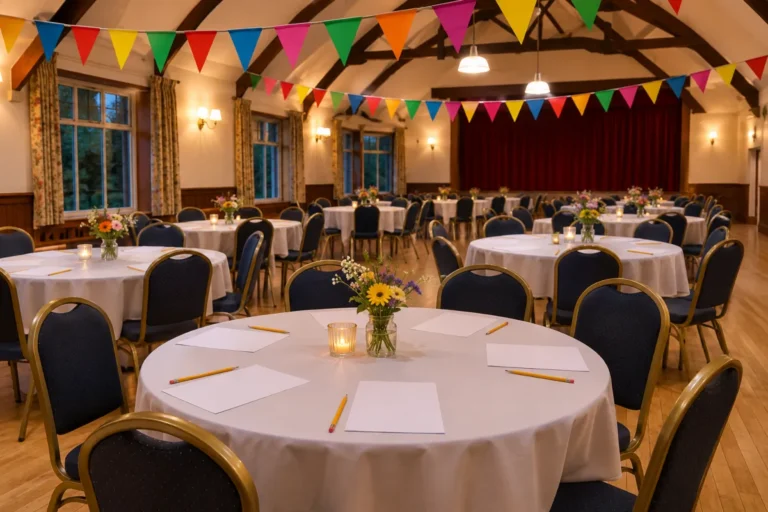
The hardest part of meeting someone new is usually the first few minutes. You walk in, scan the room for a face you have only seen in a small photo, wonder whether it is a wave, a handshake or a hug, and suddenly forget what your hands normally do. If you have been wondering how to be less awkward around new people, start with this: most of that awkwardness is far louder inside your head than it is to anyone watching.
What follows is built for real situations, whether it is a first coffee with a possible new friend, a running group where everyone seems to know each other already, or a first date in a quiet pub. You will find copy-paste scripts for arriving, joining a conversation and leaving, a before / during / after checklist, and a small-steps plan you can start with your very next plan.
None of it asks you to become a louder, shinier version of yourself. The aim is simpler: have a few lines ready, so your brain has less to improvise while it is busy feeling nervous.
Why you feel more awkward than you look
Here is the most reassuring piece of research on this topic. In a 2018 study, researchers found that across several settings people systematically underestimated how much their conversation partner liked them and enjoyed their company (Boothby et al., Psychological Science). They called it the liking gap: after a chat, we judge our own performance more harshly than the other person does.
It is not only a first-impressions thing, either. When the researchers followed students who had just started living together, the gap lingered for several months while those new relationships were forming (Psychological Science). So the cringe replay you run on the way home is not a reliable recording. It is a harsh edit.
Awkwardness around new people usually comes from three places:
- Self-monitoring. You are watching yourself talk instead of listening.
- No script. You do not know the opening move, so you freeze or over-talk.
- No exit. You are not sure how it ends, so the whole thing feels open-ended and heavy.
Knowing how to be less awkward around new people is mostly about fixing those three things, and each section below tackles one of them.

How to be less awkward around new people: four habits
1. Swap self-watching for curiosity
When you are nervous, your attention turns inward: how do I sound, is my face doing something odd? The quickest fix is to give that attention a different job. Decide before you arrive that you want to find out one genuinely interesting thing about each person you meet. Curiosity is hard to hold at the same time as self-criticism, and the other person experiences it as warmth.
2. Ask, listen, follow up
You do not need a stream of clever questions. You need one open question, then a follow-up on a detail in their answer. If someone says they have just moved from Cork, “What made you pick here?” carries the conversation further than any rehearsed line. For more openers, our list of easy small talk lines for strangers is a good one to skim on the bus.
3. Give yourself a small job
People who look relaxed at events often have something to do: ordering, pouring the tea, holding the map on a walk, helping the host stack chairs. Offering a hand gives your nerves somewhere to go and gives you an easy way into a chat. “Can I help with anything?” is one of the least awkward sentences in English.
4. Know your exit before you arrive
Awkwardness grows when a plan feels endless. Decide roughly how long you will stay and how you will get home, and pick an exit line from the scripts below. Knowing you can leave gracefully makes it much easier to stay.
A lower-pressure way to start. A lot of first-meeting nerves come from the unknowns: who will be there, whether they expect you, how to say hello. MeetNow is built around small plans at public places, where the host has accepted you and there is a group chat before you meet, so by the time you arrive you have already said hi.
Social anxiety scripts for arriving
Arrival is where most people over-think. Pick one line, say it with a smile, and let the other person carry the next beat. These social anxiety scripts are deliberately short, because short is easier to say when your heart is going.
Meeting one person (a friend or a date)
- “Hi, you must be Priya? Lovely to meet you properly.”
- “I found you! I did a lap of the café trying to work out which table was yours.”
- “I’m a couple of minutes early, so I’ve grabbed a table by the window. Blue jacket.”
- “So sorry I’m a bit late, the train had other ideas. How are you?”
Hug, handshake or wave? In the UK, Ireland and Australia, a smile and a small wave is never wrong. If they move in for a hug, go with it if you are comfortable; if not, a friendly “Hi!” while staying put is perfectly normal.
Arriving at a group
- “Hi, is this the book club? I’m Aoife, first time here.”
- “Hello, I’m new. Are you the organiser, or could you point me to them?”
- “Is anyone sitting here? I’m Tom, I heard about this through a friend.”
Saying “first time here” out loud is a gift to everyone else. Regulars usually love explaining how things work, and it takes the pressure off you to look as if you already know.

Scripts for joining a conversation that is already going
Walking up to a group mid-chat feels like interrupting, but at social events it is the expected way to meet people. Stand at the edge of the circle, catch someone’s eye and wait for a natural pause. Most groups will shuffle to make room.
- “Mind if I join you? I don’t know anyone yet.”
- “Sorry to jump in, did I hear someone mention the Lake District? I’ve been meaning to go.”
- “That sounds like a good story. What happened next?”
- “How did everyone find this group?”
- “Can I ask a newbie question? How do these usually work?”
If the chat dies, rescue it with something you can all see: the venue, the food, the route you are walking, the book everyone has read. Shared surroundings are the easiest topic there is. Our guide to starting a conversation in a group has more lines for circles of three or more.
What to do with your hands when nervous (and the rest of you)
Hands feel enormous when you are self-conscious. They are not, and nobody is looking at them as closely as you are. Still, a few small habits help you feel more settled:
- Hold something. A cup of coffee, a glass of water or your jacket gives your hands a natural resting place.
- Rest them on the table. Relaxed hands on the table or loosely in your lap read as calm and open.
- Put your phone away. Keep it in your bag or pocket so you are not tempted to scroll every time there is a pause.
- Slow your breath out. A longer, gentle exhale before you walk in can take the edge off the jitters.
- Talk a touch slower. Nerves speed us up. Slowing down slightly makes you easier to follow and buys you thinking time.
- Soft eye contact. Look at their face while they are speaking and let your gaze drift away naturally while you think.
If you fidget, that is fine too. Plenty of confident people tap a foot or twist a ring. It is not the giveaway you think it is.
What to do if nobody talks to you
It happens to everyone at some point, and it is rarely about you. People cluster with whoever they know, often because they are nervous too. A few ways through:
- Find the host. “Hi, I’m new. Is there anyone you’d suggest I say hello to?” Hosts want newcomers to have a good time and are usually glad to introduce you.
- Look for the other solo person. Someone on their own by the snacks is probably hoping for exactly this: “Are you new as well? Oh good, me too.”
- Use the activity. At a quiz, walk or class, ask a practical question: “Which way are we heading after this?”
- Set a kind limit. Agree with yourself on a short window before you arrive. If you have tried and it still feels flat, leaving is allowed, and a quiet first visit is not a failure.
Scripts for leaving politely
A warm exit leaves a better memory than a perfect conversation. Keep it short, positive and honest.
Leaving a one-to-one
- “I’ve really enjoyed this. I’m going to make a move, but shall we do it again?”
- “This was lovely, thank you. I’ve got an early start, so I’ll head off.”
- “Great to meet you properly. I’ll message you about that exhibition.”
Moving on mid-event
- “I’m going to grab some water. Really nice chatting with you.”
- “I promised myself I’d meet a few new people, so I’ll go and say hi to the others. See you in a bit.”
Leaving a group
- “Thanks so much for organising. I’ll definitely be back.”
- “I’m off, lovely to meet you all. See you next time?”
What about slipping out unannounced? Our piece on the Irish goodbye and when it is OK to use covers it properly, but the short version is this: fine at a big, loose gathering, not great at a small plan where people will notice the empty chair. A quick text to the host afterwards keeps it friendly. For many more options, see these polite ways to end a conversation.
Before, during and after checklist
If you only keep one thing from this guide on how to be less awkward around new people, make it this list. Screenshot it or copy it into your notes.
| Stage | What to do |
|---|---|
| Before |
|
| During |
|
| After |
|
Safety basics when you are meeting someone new
Feeling less awkward goes hand in hand with feeling safe. UK police guidance for meeting someone new is to choose a busy public venue, tell a friend or family member where you are going, who you are meeting and when you expect to return, and arrange your own transport there and home (Metropolitan Police). Many hospitality venues also take part in Ask for Angela: if a date or new meeting feels uncomfortable or unsafe, you can go to the bar staff, security or a manager and ask for “Angela”, and they will help you discreetly. For plans with several people, our group meetup safety checklist covers both guests and hosts.
A small-steps plan to feel less awkward around new people
Confidence with new people is built the way fitness is: small, repeated, slightly stretching. Move on to the next step when the current one starts to feel a little boring.
- Micro-chats. Say one extra sentence to a barista, shop assistant or neighbour. “That looks good, what is it?” counts.
- One question at an event. At something you already attend, such as a class or a work do, ask one person one open question.
- A short, planned one-to-one. A coffee or a walk with a clear time frame, with a friend of a friend or someone from a group chat.
- A small group. A handful of people round one table is easier than a crowded room, because there is only one conversation to follow.
- Go back. Return to the same group a second and third time. Familiar faces do a lot of the work for you.
- Host something small. A coffee, a walk or a pub quiz team. Hosting sounds daunting, but it gives you a role and a natural reason to talk to everyone.
How to go back to a group after an awkward first time
Maybe you went quiet, laughed at the wrong moment or left early. Going back can feel harder than going the first time, but remember the liking gap: the moment you keep replaying probably did not register with anyone else the way it did with you.
- Message the organiser first (optional). “Hi, I came along last time and was still finding my feet. Looking forward to the next one!” It turns you into a familiar name before you arrive.
- Use a callback. “Good to see you again. How did the half marathon go?” Remembering a detail from last time is quietly impressive.
- Skip the big apology. If you feel you must mention it, keep it light: “I was a bit all over the place last time, first-visit nerves.” Then move on.
- Arrive a little early. Joining as people trickle in is easier than walking into a full room.
If you find yourself lying awake going over every sentence, that post-event crash has a name. Our guide to the social hangover and how to recover has practical ways to settle it.
When it feels like more than awkwardness
Learning how to be less awkward around new people is a skill, and feeling a bit clumsy along the way is completely normal. If nerves are stopping you from doing things you want to do, or the worry sticks around for a long time, it is worth talking to someone. In the UK, the NHS has guidance on social anxiety and how to get support, and your GP is a good first stop. In Ireland, the HSE offers mental health information and support, again often starting with your GP. In Australia, Beyond Blue and Head to Health are good places to begin. Asking for help is a practical step, not a dramatic one.
Want to turn this into an actual plan? MeetNow is a free app for meeting people in person: a host posts a plan at a public place, says who pays (host pays, split, pay your own or free) and picks who joins. It is launching in Malta first and is not in the App Store or Google Play yet: join the MeetNow waitlist and we’ll email you when it launches near you.
FAQ
Why do I feel so awkward around new people?
Mostly because you are watching yourself closely while also improvising. Research on the liking gap shows people tend to underestimate how much new conversation partners like them, so the awkwardness you feel is usually much bigger than what others notice. Having a few prepared lines and focusing on the other person helps.
What should I say when I first arrive at a meetup?
Keep it short and honest. Something like “Hi, is this the book club? I’m Aoife, first time here” works well, because it tells people you are new and invites them to show you how things work. If you can, find the host and introduce yourself.
What should I do with my hands when I’m nervous?
Give them a natural resting place. Hold a drink or your jacket, rest them on the table or loosely in your lap, and keep your phone in your bag. A slow breath out before you walk in also helps. Small fidgets are normal and rarely noticed.
How do I go back to a group after an awkward first time?
Arrive a little early, greet someone you met before with a callback to something they mentioned, and skip the big apology. If you like, message the organiser beforehand to say you are looking forward to the next one. Most people will not remember the moment you are worried about.
Is it rude to leave an event without saying goodbye?
At a big, loose gathering, quietly slipping away is generally fine, and a quick text to the host afterwards keeps it friendly. At a small plan or a one-to-one, say a short goodbye so nobody is left wondering where you went.
When should I get support for social anxiety?
If nerves stop you doing things you want to do, or the worry lasts a long time, talk to your GP. In the UK the NHS has information and support, in Ireland the HSE, and in Australia Beyond Blue and Head to Health are good starting points.