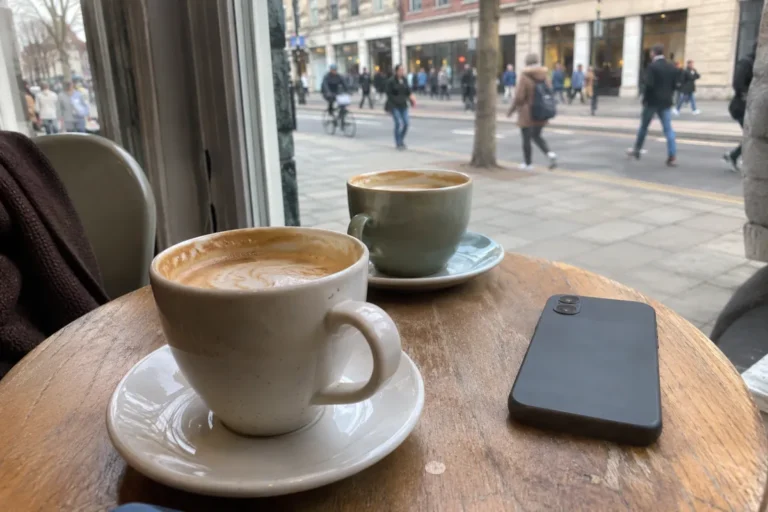
The fear of meeting new people tends to peak at one precise moment. You are outside the café, pub or park meeting point, you can see a cluster of strangers chatting, and your brain starts listing everything that could go wrong in the next hour. It is one of the most common feelings there is, and almost none of it means you are bad at people. It mostly means you are facing a lot of unknowns at once.
The fix is not to become louder or more confident overnight. It is to shrink the unknowns. Know where you are going and how you will get home, have a few lines ready to say, and give yourself permission to leave when you have had enough. That works whether you are meeting a possible new friend, a group of strangers or a first date.
Below you will find a calm prep plan and copy-paste scripts for arriving, joining a conversation that is already going and leaving. There is also advice on what to do if nobody talks to you, a before / during / after checklist, and a small-steps plan you can work through at your own pace.
Why the fear of meeting new people feels so big
Meeting someone new stacks several uncertainties on top of each other. Will I find the place? Will they like me? What will I say? How do I get out if it is awkward? Your nervous system treats all of that uncertainty as a reason to be on guard. That is why your heart races before you have even said hello.
Two things are worth knowing. First, people notice your nerves far less than you think. Psychologists call this the spotlight effect: we assume others are watching us closely, when they are mostly busy worrying about themselves. Second, at almost any meetup, book club or running group, several other people walked in feeling exactly as you do. The confident-looking person by the counter may simply have arrived ten minutes earlier and already had their first awkward hello.
So the aim is not to stop feeling nervous. It is to feel nervous and still have a plan. Nerves plus a plan can still add up to a perfectly good afternoon, a perfectly good Saturday coffee and a perfectly good first meetup.

Before you go: a calm prep plan
Much of the fear of meeting new people lives in the hours before you leave the house, so that is where a little preparation pays off most. Ten minutes of planning removes a surprising amount of dread.
- Pick a format that does some of the work for you. Activity-based plans, such as a walk, a quiz, a pottery taster or a weekend run, give you something to look at and talk about. Conversation does not have to carry the whole thing. Small groups are usually easier than big crowds.
- Read the details twice. Know the exact place, the start time, who is hosting and roughly how long it runs. If something is unclear, a short message to the host is completely normal.
- Prepare three lines. You need one way to introduce yourself, one question to ask and one exit line. You will find all three below.
- Decide your leave time in advance. Telling yourself “I will stay for an hour and then see how I feel” turns an open-ended ordeal into a fixed, manageable window.
- Sort your way home. Check your bus, train or taxi options before you go, so leaving early is always easy.
If the day before tends to be the worst part, our calm plan for anxiety before social events walks through the build-up step by step.
Should I bring a friend to my first meetup?
You can, and for some people it is the difference between going and not going. A friend makes the walk in feel less exposed and gives you someone to debrief with afterwards. The trade-off is that the two of you can end up talking only to each other, which makes you harder to approach.
If you do bring someone, check first that the plan is open to extra guests, because some hosts cap numbers. Agree beforehand that you will each talk to at least one new person, and perhaps sit apart for part of it. If bringing a friend is not possible, the next best thing is a friend on standby. Tell them where you are going and agree to text when you arrive and when you leave. Plenty of people find going solo surprisingly freeing once they have done it; our guide to going to a meetup alone has a full checklist for that.
Nervous before a group meetup? A short routine
- Eat something beforehand. Hunger and nerves feel similar and make each other worse.
- Plan to arrive on time or a few minutes early. Early arrivals meet the host and two or three people, instead of walking into a full room.
- Walk the last stretch rather than rushing. A few slow breaths outside the door is not silly; it is preparation.
- Pick your one go-to question, such as “How did you find this group?”
- Remind yourself of your leave time. You are committing to a window, not a lifetime.
A lower-pressure way to meet people: a lot of the fear of meeting new people comes from walking in cold. A small plan at a public place, where the host has already accepted you and there is a group chat before you meet, takes much of that away. That is how MeetNow, a free app launching in Malta first, is designed: plans, not profiles, so you know what the plan is and who is coming before you arrive.
Simple safety habits that make it feel less scary
Feeling safe and feeling relaxed are closely linked, so a few habits do double duty and take the edge off the nerves. Whether it is a new friend, a group or a date, the basics are the same:
- Meet in a public place the first time, ideally somewhere busy and well lit, such as a café, a pub with seating or a popular park.
- Tell a friend where you are going, who you are meeting and roughly when you expect to be done.
- Get yourself there and back. Having your own way home means you never depend on anyone else to leave.
- Leave if you feel uncomfortable. You do not need a reason, an excuse or permission.
These habits are about practicality, not fear. The Office for National Statistics found that half of women (50%) in Great Britain felt unsafe walking alone in a busy public place after dark, compared with 19% of men (ONS). That is one good reason why daytime and early-evening plans, and a route home you already know, feel so much easier for many people. If the person you are meeting comes from an app, a quick video call beforehand is a sensible norm. Research from the Australian Institute of Criminology reported that three in four (73%) dating app users in Australia had experienced some form of sexual violence facilitated by these platforms (Australian Institute of Criminology). None of this is a reason to stay home; it is a reason to keep the simple habits above. Hosts and guests can find more in our group meetup safety checklist.

Arriving: how to introduce yourself to a group
The first two minutes feel the biggest, so make them the most scripted. Use a simple formula: your name + that you are new + one easy question. You do not need anything clever. Friendly and clear beats witty every time.
Copy-paste scripts for arriving
- To the host: “Hi, I’m Sam, I think I’m here for the walking group? It’s my first time.”
- To a small group at a table: “Hi, is this the book club? I’m Priya, it’s my first one. Mind if I grab this seat?”
- To one person standing alone: “Hi, are you here for the meetup too? I’m Aoife, I’m new.”
- Meeting one new friend: “You must be Jess. So nice to finally meet in person. Shall we order?”
- A first date: “Hi, Tom? Great to meet you properly. Did you find it OK?”
If you are running late
Send a short message rather than an essay: “Running about ten minutes behind, so sorry. Go ahead and start, I’ll find you.” When you arrive, a quick “Sorry I’m late, I’m Ben” is all anyone needs.
Introducing yourself when a group is mid-chat
If a whole group is already seated, speak to the nearest one or two people rather than the entire table. Say your name once, clearly, and do not worry about remembering everyone else’s straight away. “I’m terrible with names, can you tell me yours again?” is a completely normal thing to say a little later.
Joining a conversation that is already going
Joining a conversation in full flow is often the part people dread most. Breaking it into steps helps:
- Move to the edge of the group, facing them, with a drink in your hand if that helps.
- Listen for a minute and catch the topic. Nod, smile and react.
- Wait for a natural pause, or for someone to glance your way.
- Add to the topic rather than changing it. A question is the easiest way in.
Scripts for joining in
- “Sorry to jump in, did you say you did the coastal walk? I’ve been meaning to try it.”
- “Mind if I join you? I’m new and you look like you know how this works.”
- “That sounds like a great story. What happened next?”
- “Is this your first time too, or are you regulars?”
Open questions that start with how, what or why keep things moving far more easily than yes-or-no questions. For more openers and ways to keep a group talking, see our scripts for starting a conversation in a group.
What to do if nobody talks to you
Sometimes you arrive, say hello, and the conversation simply closes back up. It stings, but it is rarely about you. Groups often settle into little clusters of people who already know each other, and they are not always good at noticing who is standing at the edges. These moves help:
- Find the host. Hosts usually want newcomers to have a good time. “Hi, I’m new and finding my feet. Who should I say hello to?” gives them an easy job.
- Find the other solo person. There is almost always one. Try: “Are you here on your own too? Want to be first-timers together?”
- Offer to help. Handing out quiz sheets, fetching a jug of water or helping set up gives you a role and a reason to chat.
- Ask a practical question. “Do you know what time the walk starts?” is easy to answer and often leads somewhere.
- Take a short reset. Step outside for some air or pop to the loo, then come back and try one new person.
- Stick to your leave time. If you gave it a fair go and it still was not working, going home is not failure. It is useful information. Try a different group, or the same group again: the second visit is almost always easier.
Leaving politely (and when an Irish goodbye is fine)
Knowing you can leave gracefully makes it far easier to stay. Keep exits short, warm and forward-looking.
Copy-paste exit scripts
- To the person you are chatting with: “I’m going to head off, but it was really lovely to meet you.”
- With a soft reason: “I’ve got an early start, so I’ll call it there. Hope the new job goes well!”
- To the host: “Thanks so much for organising. I had a nice time and I’d like to come to the next one.”
- Leaving a date that went fine: “I’ve really enjoyed this. I’m going to make a move, but let’s message.”
- Leaving when you are uncomfortable: “I’m going to go.” Nothing more is needed.
The Irish goodbye
Slipping out without a round of goodbyes is fine at a big, casual event where nobody is relying on you. It is less fine in a small group, on a date, with the host or with anyone you arrived with, because people may worry about where you went. A quick message afterwards solves most of that: “Had to dash, thanks for a lovely afternoon!” Our guide to the Irish goodbye and when it is OK to use covers the etiquette in more detail.
After: the overthinking and the social hangover
You get home and the replay starts: the joke that did not land, the name you forgot, the moment you talked too much. Feeling drained and a bit raw after meeting new people is very common, and it has a name: the social hangover.
- Rest first, review later. Tired brains are harsh critics. Leave the post-mortem until you have slept.
- Write down three things that went fine. You went. You introduced yourself. Someone laughed at something you said. These count.
- Send one easy follow-up if you clicked with someone: “Lovely to meet you at the quiz! Are you going to the next one?”
- Remember the spotlight effect. The moment you keep replaying is very likely one nobody else noticed.
If you often feel wiped out for a day or two afterwards, our guide to the social hangover and how to recover has practical ways to bounce back.
Before, during and after checklist
Screenshot this, or copy it into your notes app, and tick it off as you go.
| Stage | Tick off |
|---|---|
| Before | Place, start time and host details checked |
| Before | Route home and transport options sorted |
| Before | A friend knows where you are going and when you expect to be done |
| Before | Three lines ready: an introduction, a question and an exit |
| Before | Leave time decided, phone charged, something eaten |
| During | Texted your friend when you arrived |
| During | Introduced yourself to one person, not the whole room |
| During | Asked at least one open question |
| During | Checked in with yourself: comfortable, OK or ready to go? |
| After | Texted your friend that you are home |
| After | Rested before reviewing how it went |
| After | Wrote down three things that went fine |
| After | Sent a follow-up if you clicked with someone |
A small-steps plan for the fear of meeting new people
Confidence with strangers is built the way fitness is: small, repeated efforts that stretch you slightly. Work through these at your own pace, and move on when a step feels boring rather than scary.
- Warm up with micro-chats. Say a little more than usual to a barista, a neighbour or a colleague you rarely talk to.
- Go to one activity-based event and stay for your planned window, even if you only talk to one person.
- Introduce yourself first to one person at your next event, using your script.
- Join one conversation that is already going, with a question about the topic.
- Go back to the same group. Familiar faces are the quickest cure for first-time nerves, and regulars start saying hello to you.
- Suggest a small plan yourself, such as a coffee with two people you met, or a walk before the next session.
Some steps will go better than others. That is the plan working, not failing.
When to look for extra support
Plenty of people feel nervous before meeting someone new and find it eases with practice. If the fear of meeting new people is stopping you from doing things you want to do, keeps you on edge for days beforehand, or does not ease over time, it is worth talking to someone. Your GP is a good first step. In the UK, the NHS website has information about social anxiety and talking therapies. In Ireland, the HSE offers mental health information and support. In Australia, Beyond Blue and Head to Health are good places to start. Asking for help is a practical step, just like planning your route home.
Want to turn this into an actual plan? MeetNow is a free app for meeting people in person: a host posts a plan at a public place, says who pays (host pays, split, pay your own or free) and picks who joins. It is live on the web and works in your browser, starting in Malta. The Android app is on Google Play; the iPhone app is not in the App Store yet. Open MeetNow and see the plans posted in Malta.
Frequently asked questions
Is fear of meeting new people normal?
Yes. Feeling nervous before meeting strangers is extremely common, and plenty of people at any meetup feel the same way you do. It usually eases with practice and a bit of planning. If it stops you doing things you want to do or does not ease over time, talk to your GP or a support service such as the NHS, HSE, Beyond Blue or Head to Health.
Should I bring a friend to my first meetup?
You can, as long as the plan is open to extra guests, so check with the host first. Agree that you will each talk to at least one new person so you do not only chat to each other. If bringing someone is not possible, tell a friend where you are going and text them when you arrive and leave.
How do I introduce myself to a group of strangers?
Use a simple formula: your name, that you are new, and one easy question. For example: “Hi, I’m Sam, it’s my first time. How did you find this group?” Speak to the nearest one or two people rather than the whole table.
What can I do if I feel nervous before a group meetup?
Eat beforehand, plan to arrive on time or a little early, prepare one go-to question and decide how long you will stay. Knowing your route home and having a leave time turns an open-ended event into a manageable window.
Is it rude to leave a meetup early?
No. A short, warm exit such as “I’m going to head off, it was lovely to meet you” is perfectly polite. Thank the host if there is one. If you leave quietly from a large, casual event, a quick message afterwards covers it, and if you feel uncomfortable you can leave without giving any reason.
What if nobody talks to me at a meetup?
It is rarely personal: groups often cluster around people they already know. Find the host, look for another solo person, offer to help with something or ask a practical question. If it still is not working by your planned leave time, go home and try again, or try a different group.