A coffee lasts as long as the cup, but a dinner lasts as long as the kitchen. That one difference sits at the heart of the coffee date vs dinner date first meeting question, and it matters more than the menu, the venue or what you wear. When you’re about to meet someone from an app, a club or a friend of a friend, the format you choose decides how easily you can leave, how much pressure you both feel and how much you actually learn about each other.
For most first meetings, coffee is the calmer bet. But “always do coffee” isn’t the whole answer. Some people freeze over a flat white and relax over a shared plate of pasta. Some situations, such as a match who lives a long train ride away or someone you’ve already had a long video call with, genuinely suit a meal. Below you’ll find a side-by-side comparison, a decision checklist, word-for-word example messages, question banks for each format and a few middle-ground plans.
Everything here works whether the person across the table is a potential date or a potential new friend. Swap “date” for “meetup” wherever it suits you.
Coffee date vs dinner date first meeting: side by side
Here’s how the two formats compare on the things that actually shape a first meeting.
| Factor | Coffee date | Dinner date |
|---|---|---|
| Typical length | Short and open-ended: one drink, maybe two | Set by the courses, usually much longer |
| Time of day | Morning, lunch break or afternoon | Usually evening |
| Ease of leaving | Easy: finish your cup and go | Harder: leaving mid-meal feels like a statement |
| Time lost if it doesn’t click | A slice of your morning | A whole evening |
| Conversation support | Little to fill silences; a walk afterwards helps | Menu, food and staff give you prompts |
| Expectations | Casual, friendly, low pressure | Often reads as more romantic or serious |
| Drink safety | Usually ordered at the counter and kept in hand | Drinks sit on the table, sometimes unattended |
| Best for | First meetings, nervous daters, new friends | Second meetings, people you’ve already spoken to properly |
Notice that most rows aren’t about food at all. They’re about time, exits and expectations. That’s why the choice matters far more on a first meeting than it does on a fifth.
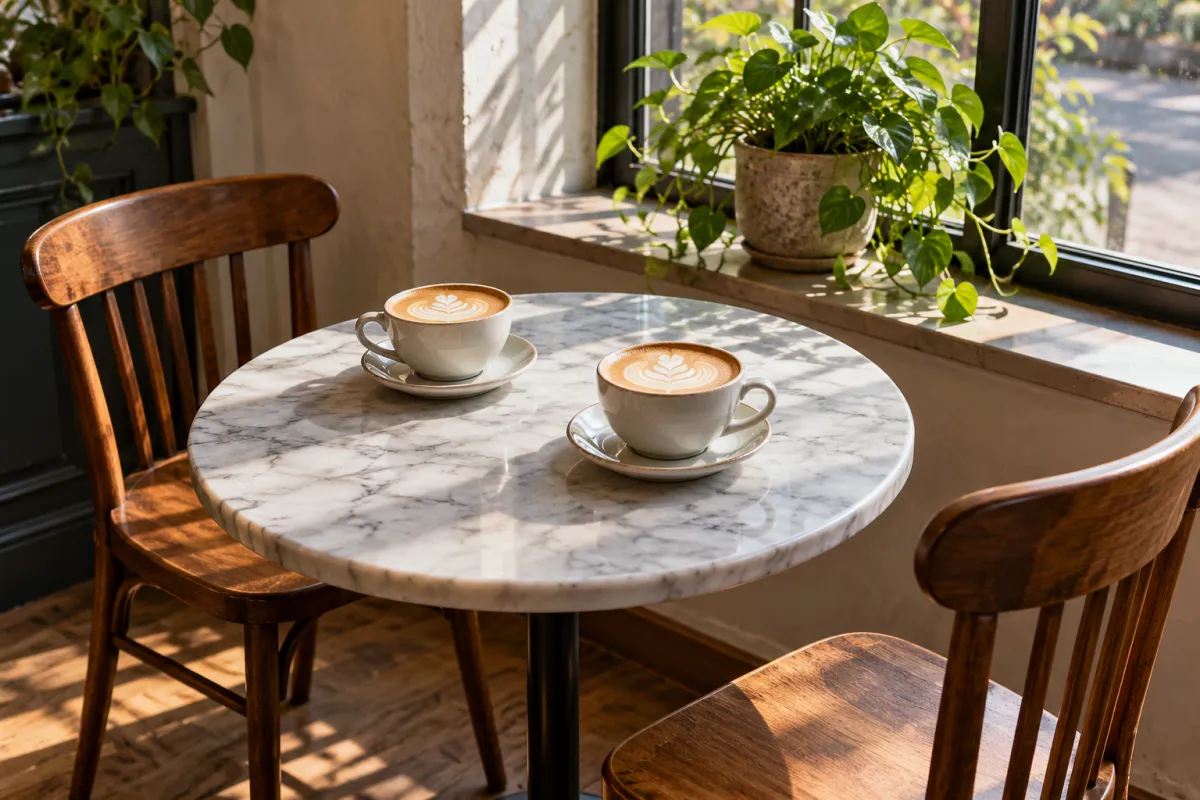
Why coffee usually wins for a first meeting
A first meeting has one job: to find out whether you’d like to see this person again. You don’t need a three-course evening to answer that. Often you can tell fairly quickly whether the conversation flows, whether they’re kind to the barista and whether they match their photos and messages.
It has a natural end point
When the cups are empty, the meeting can end without anyone needing an excuse. “Right, I’d better head off” lands lightly after coffee. Said after the starter but before the main, the same line feels pointed. That built-in exit window takes a lot of pressure off both of you, especially if you’re nervous or simply not sure yet.
It fits daylight hours
Coffee slots neatly into a weekend morning or a weekday lunch break. A busy café in daylight is visible, public and full of people, and getting home is simpler while it’s still light. You also have the rest of the day to yourself afterwards, whether you want to debrief with a friend or just get on with your errands.
It’s easier to keep control of your drink
In most cafés you order at the counter and carry your cup straight to the table, so it stays in your hand or right in front of you. At dinner, drinks often sit on the table while one of you pops to the loo or steps outside to take a call. That’s easy to manage, but it’s one more thing to keep in mind.
It’s a small investment if it doesn’t click
If the chemistry isn’t there, you’ve spent a short stretch of your morning, not a whole evening. That makes it easier to say yes to meeting in the first place, and easier to be generous and give someone a chance.
You can always extend it
A coffee that’s going well can turn into a walk, a browse around a market or lunch. Extending a meeting is a compliment; cutting one short is awkward. Starting small keeps both options open.
When a dinner date makes sense for a first meeting
In the coffee date vs dinner date first meeting debate, coffee is the sensible default, not a rule. A dinner can be the better first meeting when:
- You’ve already spoken properly. A video call or a long phone chat means you’ve cleared the “are they who they say they are” stage and you know the conversation flows.
- You’re meeting through people you know. A friend of a friend, or someone from a club you’ve both attended for months, comes with context and shared contacts.
- Distance makes a short meeting impractical. If one of you is travelling a long way, a quick coffee can feel like an odd use of the journey.
- Food is genuinely your shared thing. Two people who’ve spent a week swapping restaurant recommendations may find a meal more natural than a café.
- Evenings are the only time either of you is free. Shift work and long commutes are real, and a sensible early dinner beats never meeting at all.
How to make a first dinner lighter
- Choose lunch instead of dinner if you can. Same food, daylight, and an afternoon to get on with afterwards.
- Book an early evening table rather than a late one, so getting home is straightforward.
- Pick somewhere with small plates or a short menu, so the meal only stretches out if you both want it to.
- Choose a busy, central restaurant you already know rather than somewhere quiet and out of the way.
- Skip the tasting menu. It locks you in for hours and leaves no graceful exit.

Decision checklist: coffee, dinner or something else?
Run through this before you reply to that “so when are we meeting?” message. If you tick most boxes in one list, that’s your answer.
Choose coffee if…
- You’ve only messaged in the app or by text so far.
- You’re nervous, or you don’t know yet whether you’re interested.
- You’d like the option to leave easily.
- You’d prefer to meet in daylight.
- You want to keep the rest of your day free.
- It’s a first meetup with a potential friend rather than a date.
Choose dinner if…
- You’ve had a video or phone call and it went well.
- You have mutual friends or a shared group.
- You both brought up food early on and it feels natural.
- You’re comfortable getting yourself home from the venue.
- You’re happy to commit to a longer evening, even if it turns out to be only “fine”.
Choose something else if…
- You find sitting face to face for a long time tiring: try a walk or a gallery.
- You worry about silences: pick an activity that gives you something to look at.
- You’d rather skip caffeine and alcohol: a walk, a market or a museum works well.
- There’s a good free event coming up near you that you’d both enjoy.
Worked example dialogues for each option
The wording you use to suggest a plan sets the tone. These examples are short, friendly and specific. Adjust the details to your own town.
Suggesting coffee for a first meeting
You: “I’ve really enjoyed chatting. Fancy grabbing a coffee this weekend? There’s a nice café near the station I like. Saturday late morning?”
Them: “Sounds good, I’m free Saturday.”
You: “Great. Shall we say eleven? I’ll be the one in the green scarf.”
Why it works: it names a day, a rough time and a type of place, so the other person only has to say yes. Suggesting a public spot you already know also means you’re on familiar ground.
When they suggest dinner and you’d rather do coffee
Them: “Want to get dinner on Friday? I know a great Italian place.”
You: “I’d love to try it sometime! For a first meet I usually prefer a coffee, it’s more relaxed. How about Saturday morning, and if we get on, the Italian can be next?”
Why it works: it’s warm, it doesn’t reject them, and it turns their idea into a natural second date. Anyone reasonable will be fine with it. If someone pushes hard against a short, public first meeting, that tells you something useful too.
Suggesting dinner without making it feel heavy
You: “Our video chat flew by. Want to carry on over food? I was thinking an early dinner on Thursday at that tapas place in town. Small plates, nothing fancy.”
Them: “Love tapas. Thursday works.”
Why it works: “early”, “small plates” and “nothing fancy” all lower the stakes. You’re suggesting a meal, not an occasion.
Turning a good coffee into something longer
You: “I’m having a really nice time. I was going to walk along the river after this. Want to come, or do you need to head off?”
Them: “Yeah, I’ve got time. Let’s go.”
Why it works: it offers an easy “no”. The other person can decline without any awkwardness, which makes a “yes” mean more.
Ending a coffee that isn’t clicking
You: “This has been lovely, thanks for meeting up. I’m going to head off, I’ve got a few things to sort this afternoon.”
Them: “Oh, sure. Thanks for coming.”
Why it works: it’s polite, honest enough and final. You don’t owe a long explanation. For more wording, including what to say when you do want a second meeting, see our guide on how to end a first date, with lines for every outcome.
What to talk about: question banks for coffee and dinner
The format changes the conversation. Coffee rewards quick, light questions that are easy to answer. Dinner gives you time to go deeper, and the food itself gives you something to talk about when things slow down.
Coffee questions: light and quick
- What’s been the best part of your week so far?
- Are you a coffee person or a tea person, and how fussy are you about it?
- What do you usually do on a free Saturday?
- What’s a place nearby you’d recommend to someone new to the area?
- What are you looking forward to this month?
- Have you watched or read anything good lately?
- What did you want to be when you were younger?
- What’s a small thing that always improves your day?
Dinner questions: slower and deeper
- What’s the best meal you’ve ever had, and who were you with?
- Is there a dish from your childhood you still crave?
- Where’s the best place you’ve travelled, and would you go back?
- What’s something you’ve changed your mind about in the last few years?
- What does a really good weekend look like for you?
- What are you learning or working on outside your job?
- Who in your life makes you laugh the most?
- What’s something people often get wrong about you?
Need more? Our list of first date conversation starters has plenty more questions sorted by mood, and they work just as well for a first meetup with a new friend.
Worked example: keeping a coffee chat flowing
You: “So what do you usually get up to at weekends?”
Them: “Honestly, a lot of walking. I’ve been trying a different coastal path every month.”
You: “Oh, nice. Which has been the best one so far?”
Them: “Probably one up the coast. The views were unreal.”
You: “I’ve never done it. Is it the sort of walk a beginner could manage?”
Why it works: each follow-up picks up a detail from their last answer. You don’t need a long script; you just need to listen for the next thread.
Middle ground: free first date ideas and a museum first date
If neither coffee nor dinner feels quite right, an activity can give you the short, low-pressure feel of coffee with something built in to talk about. These free first date ideas also suit anyone who’d rather not drink caffeine or alcohol, and they work equally well for meeting a potential friend.
A museum first date
A museum first date might be the most underrated first meeting going. The exhibits do half the conversational work (“Would you have this in your living room?”), you walk side by side rather than staring at each other across a table, and closing time gives you a natural end point. Many public museums and galleries offer free entry to their permanent collections, so check the official website of the one near you before you go. Suggest meeting at the entrance, wander for a while, then decide together whether to sit down in the café.
More free first date ideas
- A walk along a canal, river, beach or coastal path, ideally a well-used route in daylight.
- A browse around a weekend market; you don’t have to buy anything.
- A botanic garden or a large city park.
- A free talk, reading or exhibition opening at a library or community space.
- A bookshop browse where you each pick out something for the other to flick through.
For many more plans that suit both dates and new friends, see our daytime first date ideas for dates and friends.
Safety checklist for coffee or dinner
Whichever format you choose, the same few habits keep a first meeting relaxed rather than risky. Most first meetings are simply pleasant or a bit awkward, but harm does happen: an Australian Institute of Criminology study found that approximately one in three survey respondents had experienced in-person sexual violence by someone they met through a dating app or website (Australian Institute of Criminology). The point isn’t to be scared; it’s to make the safe choices automatic, so you can relax and enjoy the conversation.
- Meet in a busy public place. A central café or restaurant you already know is ideal for both formats.
- Tell a friend the plan. Who, where and when. You can also share your location with a friend before the date using our step-by-step guide.
- Arrange your own way there and back. South Australia Police advise driving yourself, taking public transport or booking your own rideshare rather than relying on your date to pick you up or drop you off (SA Police).
- Set up a check-in. Ask a friend to text or call at an agreed time during the meeting, which gives you an easy way out if you want one.
- Keep your address and workplace to yourself until you’ve built some trust.
- Keep your drink with you. Don’t leave food or drinks unattended; that’s simpler at a café counter than at a dinner table, but it’s worth remembering at both.
- Know about Ask for Angela. The Metropolitan Police explain that if someone you’re with makes you feel unsafe, you can discreetly ask venue staff for “Angela” and they’ll help you get away (Metropolitan Police). It’s mainly promoted in bars, pubs and restaurants, so you’re more likely to find it at a dinner venue than a café. Our guide to how Ask for Angela works in the UK, Ireland and Australia explains more.
- Leave if you’re uncomfortable. You don’t need a reason. Stand up, say goodbye and go. A short format makes that easier, but it’s your right at dinner too.
How long to stay, and how to wrap up
A coffee date usually runs for about the length of one drink, perhaps a second if things are flowing. A first dinner tends to last as long as the meal, which is why it’s worth choosing a venue that doesn’t stretch to many courses. For a fuller breakdown by type of plan, see our guide on how long a first date should last.
Two habits help with both formats:
- Decide your rough end time before you arrive and mention it lightly early on: “I’ve got until about lunchtime.” It sets expectations and makes leaving easy whichever way it goes.
- End on a high if it’s going well. Leaving while you’re both still enjoying yourselves makes a second meeting more appealing than staying until the conversation runs dry.
If it does go well, coffee first and dinner second is a lovely path. So the short answer to the coffee date vs dinner date first meeting question is often “both, in that order”: the low pressure of coffee, then the warmth of a shared meal once you know you like each other.
Want to turn this into an actual plan? MeetNow is a free app for meeting people in person: a host posts a plan at a public place, says who pays (host pays, split, pay your own or free) and picks who joins. It is live on the web and works in your browser, starting in Malta. The Android app is on Google Play; the iPhone app is not in the App Store yet. Open MeetNow and see the plans posted in Malta.
Frequently asked questions
Is a coffee date or a dinner date better for a first meeting?
For most people meeting someone new, a coffee date is better. It’s shorter, works in daylight, is easy to leave and keeps the pressure low. Dinner suits a second meeting, or a first one where you’ve already had a video call and know you get on.
Is it rude to suggest coffee if they suggested dinner?
No. Suggesting coffee for a first meeting is common and sensible. Keep it warm, for example by saying you’d love to try their restaurant as a second date. A reasonable person will be happy with that.
How long should a coffee date last?
Roughly as long as one drink, with the option to extend into a walk or lunch if it’s going well. Setting a loose end time beforehand makes it easy to leave either way.
Is a dinner date safe for a first meeting?
It can be, as long as you follow the same habits as for any first meeting: a busy public venue, a friend who knows your plan, your own transport there and back, your drink kept with you, and the freedom to leave whenever you want. An early table at a central restaurant you know is a good choice.
What are good free first date ideas instead of coffee or dinner?
Try a walk along a well-used river, canal or coastal path in daylight, a browse around a weekend market, a botanic garden, a free talk at a library, or a museum first date at a museum or gallery with free entry to its permanent collection.
Does the same advice apply to meeting a new friend?
Yes. A short coffee is just as useful for a first meetup with a potential friend, and the safety habits are identical. If you click, a longer meal or activity makes a natural second plan.