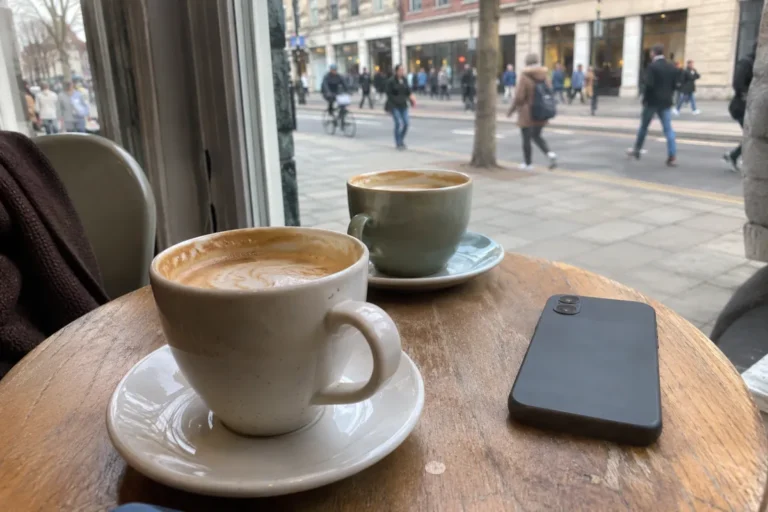
The awkward bit after a good first meetup is rarely whether you got on. It is the silence afterwards, when two people who both enjoyed themselves sit with their phones, each wondering who should suggest the second meetup and each hoping the other goes first. The honest answer is simple: whoever wants to meet again should say so, within a day or two, with one clear idea and an easy way out.
That holds whether you met a potential friend at a pottery class, a match from an app or a few people from a local walking group. The old scripts about the man always asking, or the person who organised the first meetup having to organise the second, don’t hold up well, and nobody in the UK, Ireland or Australia publishes an official rule on it. Safety guidance focuses on how and where you meet, not on who asks.
Below you’ll find a do/don’t table, copy-paste scripts for friends, groups and dates, plus the small practical pieces around the second meetup itself: the confirmation text, the greeting and what to do with your phone.
Either person can suggest the second meetup, and the one who is keenest usually should. Send a short, specific message within a day or two, offer one plan with a day and a public place, and make it easy to say no. If they reply warmly but vaguely, try once more with a concrete option; if they go quiet, let it go.
Who should suggest the second meetup? The short answer
Interest decides, not role. If you enjoyed it and want to do it again, you are the right person to suggest it. Waiting to be asked feels safer, but it mostly produces two people waiting.
So who should suggest the second meetup when you both seem equally keen? A few tiebreakers help:
- Take turns. If they organised the first meetup, it’s a kind gesture for you to suggest the second. Turn-taking keeps the effort balanced, which matters a lot in new friendships.
- Balance the travel. If one of you crossed town to get there, the other can suggest somewhere closer to them next time.
- Follow the loose thread. If either of you said “you’d love the farmers’ market on Saturdays” or “I’ve been meaning to try that climbing wall”, the person who mentioned it has a natural opening.
- Ask even when unsure. A light, specific suggestion gives the other person a clean chance to say yes or no. Staying silent gives them nothing to respond to.
A quiet advantage: being the one who suggests means you choose the place, the time and roughly how long it lasts. If you are thinking about safety, that’s real control: you can pick a busy café you know, a daytime slot and an activity with a natural end point.

Signs they would welcome a second meetup
You can’t read minds, but a first meetup usually leaves clues. Look for a few of these together rather than relying on one:
- They asked follow-up questions and remembered details about you.
- The conversation ran over the time you’d planned, and neither of you rushed off.
- They mentioned something specific you could do together.
- They messaged afterwards to say they got home safely or that they enjoyed it.
- They said “we should do this again” and then added a detail, like a day or a place.
A note on that last one: across the UK, Ireland and Australia, “we must do this again” is often friendly filler, said to colleagues and neighbours alike. Treat it as an open door, not a booking. A concrete suggestion from you is the polite way to find out whether they meant it.
Signals to hold back on: one-word replies, glances at the time throughout, or an early exit with a vague reason. And if anything about the first meetup left you uneasy, you owe nobody a second one. Our guide to saying no to an invitation politely has wording for exactly that moment.
Friends, groups and dates: who usually asks
New friends
Suggesting a second meetup with a potential friend can feel more exposed than asking someone on a date, because there’s no shared script for it. That’s exactly why it helps to be the one who goes first. Most people are flattered to be asked, and many are relieved someone else made the move.
With friends, momentum matters more than perfection. A second meetup that’s a small step from the first (the same café, a walk instead of coffee, a market you both mentioned) is easier to say yes to than a big plan. After two or three meetups, try to share the asking so it doesn’t quietly become one person’s job.
Groups
In a group, the host normally sets the next date, so the question of who should suggest the second meetup is mostly settled: you just turn up again. It gets more interesting when you click with one or two people and want to see them outside the group. That’s fine to suggest, as long as you don’t pull people away from the host’s event or invite some people in front of others who weren’t asked. On plan-based apps such as MeetNow, the host posts the next plan at a public place and people ask to join, so the follow-up is built in.
Dates
Either person can suggest a second date, regardless of gender. If you want help with the first message after meeting, our list of what to text after a first date covers thank-yous and openers. If you enjoyed their company but felt no spark, be clear before agreeing to a second meetup; this guide on telling someone you only want friendship has kind, direct scripts.

Second meetup etiquette: do and don’t
There’s no single rule on who should suggest the second meetup, but there are clear habits that make the ask easy to receive. Keep this table handy:
| Do | Don’t |
|---|---|
| Suggest within a day or two, while it’s fresh | Wait a week to seem relaxed, then wonder why it fizzled |
| Offer one specific plan: a day, a place, an activity | Send “we should hang out sometime” and leave it there |
| Pick a public place you can both reach easily | Jump to their flat, your flat or somewhere remote |
| Give it a natural end point: a walk, a class, one coffee | Propose an open-ended full day for the second meeting |
| Make it easy to decline with “no worries if not” | Pile on questions or push with “oh, come on” |
| Send one gentle follow-up if there’s no reply | Send three messages in a row |
| Accept a no or a vague answer gracefully | Ask for reasons or argue with their answer |
| Share the asking over time | Keep score out loud with “I always organise” |
Copy-paste scripts for suggesting a second meetup
Short beats clever. Each script below names something from the first meetup, offers one option and leaves room for a no. Change the place and day to fit your own plans.
To a new friend
“I really enjoyed that coffee. Fancy doing it again? There’s a Sunday market by the canal I keep meaning to try, maybe next weekend?”
“That was such a good chat. Are you free for a lunchtime walk one day next week? Tuesday or Thursday both work for me.”
“You mentioned you’d never tried bouldering. I go to a wall near the station most Saturdays. Want to come along next time? Totally fine if it’s not your thing.”
To someone from a group
“Lovely to meet you at the book swap. I’m grabbing a coffee before the next one if you want to join me beforehand?”
“A few of us from the walk are getting brunch afterwards next time. Want to come?”
“Really enjoyed chatting at run club. If you ever fancy a slower recovery jog during the week, I’m keen.”
To a date
“I had a really good time. Would you like to do something again? I was thinking that dumpling place you mentioned, maybe Saturday lunchtime?”
“Thanks for a lovely afternoon. I’d like to see you again if you’re up for it. Free one day next week?”
“No pressure at all, but I’d be up for round two. A walk along the seafront and a coffee sometime this weekend?”
The one gentle follow-up
“Hope your week’s going well! Still up for that market at some point? Happy to find another weekend if this one’s busy.”
“No stress if you’re snowed under. If you’d like to meet again, just let me know a day that suits.”
After that, stop. One follow-up is friendly; two starts to feel like pressure.
Saying yes, or saying not yet
“Yes, I’d love that. Saturday works. Shall we meet at the market entrance at 11?”
“Thanks for asking! I’m away this weekend, but how about the one after?”
Saying no kindly
“Thanks so much for asking, and I enjoyed meeting you. I don’t think I’ll take it further, but I wish you all the best.”
“That’s kind of you. I’m going to pass, but thanks again for the coffee.”
“I really enjoyed talking, but I’m only looking for friendship. If that works for you, I’d be happy to meet again.”
Before and during the second meetup
The text to confirm plans the day before
A short text to confirm plans the day before is good manners, not neediness. It catches mix-ups about the place or time, gives both of you an easy moment to move things, and quietly signals you’re still looking forward to it.
“Looking forward to tomorrow! Still good for 11 at the market entrance?”
“Just checking we’re still on for the walk tomorrow. I’ll be at the café by the park gates.”
“Hi! Still on for lunch tomorrow? If anything’s come up, totally fine to move it.”
If something has come up on your side, say so as early as you can and offer a new option in the same message. Our guide to rescheduling plans politely has templates that don’t sound like excuses.
How to greet someone you meet for the first time (and the second)
On a second meetup you’ve already broken the ice, but greetings can still wobble: hug, wave, handshake? Knowing how to greet someone you meet for the first time helps here too, especially if the second meetup brings new faces from a group.
- Lead with a smile and their name: “Hi Sam, good to see you.”
- Follow their lead on touch. Across the UK, Ireland and Australia, a wave, a handshake or a brief hug are all normal between new friends, and none of them is rude.
- If you’re unsure, keep it light: “Hug or wave?” turns the awkward moment into a small shared joke.
- Introduce yourself to anyone new with a line of context: “I’m Priya, I met Sam at run club.”
Phone etiquette when meeting someone
Good phone etiquette when meeting someone is mostly about attention. Put your phone face down or in your bag, and if you’re expecting an important message, say so at the start so a glance doesn’t read as boredom.
- Mention it up front: “My sister might ring about the dog, so I’ll keep it short if she does.”
- Take photos only with consent, and don’t post the other person without asking.
- A quick safety check-in with a friend is fine. You don’t need to hide it; “just letting my flatmate know I’m here” is perfectly normal.
- If you need to check directions or the time, say so rather than scrolling in silence.
Keeping the second meetup safe
A good first meetup builds trust, and that’s how it should be. It’s still worth keeping your usual habits for the second, because you know someone a little better, not fully. In national research with nearly 10,000 dating app and website users, “one in three survey respondents (33%) experienced in-person dating app-facilitated sexual violence” (Australian Institute of Criminology).
That’s not a reason to stop meeting people; plenty of meetups are simply pleasant. It is a reason to keep the second meetup on your terms. The institute has also taken its findings to industry and urged platforms to build in “Safety by Design” principles (Australian Institute of Criminology), but the habits below are the ones you control yourself:
- Public place again. A busy café, park, market or class. There’s no rule that a second meetup has to be more private than the first.
- Tell a friend. Share where you’re going and who with, or share your location with a friend for the duration.
- Your own way home. Travel there and back independently, even if they offer a lift.
- Leave if uncomfortable. “I’m going to head off now, thanks” is a complete sentence. You don’t need a story.
- Same standards for friends and groups. These habits apply to a new friend or a small spin-off group as much as to a date.
Pressure around the second meetup is itself worth noticing. Someone who pushes for a private venue, gets irritated when you suggest a public one, or won’t take “not this weekend” for an answer is telling you something useful.
If they don’t reply or say no
You suggested a second meetup, sent one friendly follow-up and heard nothing. It stings, but silence after a first meetup is common and usually says more about the other person’s capacity or confidence than about you. Our guide to ghosting after a first meeting covers why it happens and a short closing message if you want one.
If they reply with a soft “maybe, things are hectic”, leave the ball with them: “No worries at all. If things calm down and you fancy it, give me a shout.” Then get on with your week. If they come back, lovely; if not, you’ve lost nothing by being clear and kind.
And if they say no outright, thank them. “Thanks for letting me know, take care” closes the door warmly, which is what you’d want if the roles were reversed.
Want to turn this into an actual plan? MeetNow is a free app for meeting people in person: a host posts a plan at a public place, says who pays (host pays, split, pay your own or free) and picks who joins. It is live on the web and works in your browser, starting in Malta. The Android app is on Google Play; the iPhone app is not in the App Store yet. Open MeetNow and see the plans posted in Malta.
Frequently asked questions
Should the man always suggest the second date?
No. Either person can suggest a second date, whatever their gender. The person who most wants to meet again is usually the best one to ask, and suggesting it yourself lets you choose a public place and a time that suits you.
How long should I wait before suggesting a second meetup?
A day or two after the first meetup is a good window. It shows interest while the conversation is still fresh. Waiting a week or more to seem relaxed often lets the momentum fade, though a later message is still better than none.
Is it pushy to suggest a second meetup if they haven’t messaged?
No. One clear, friendly suggestion with an easy way to decline is polite, not pushy. Pushy is sending several messages without a reply or arguing with a no. Send one suggestion, one gentle follow-up at most, then let it rest.
What if I only want to be friends after the first meetup?
Say so before agreeing to a second meetup, kindly and plainly. Something like: I really enjoyed talking, but I’m only looking for friendship, and if that works for you I’d be happy to meet again. It saves both of you from mixed signals.
Who should suggest the second meetup in a group?
In most groups the host sets the next date, so guests simply turn up or sign up again. If you click with one or two people and want to meet them separately, it’s fine to suggest it, as long as you don’t pull people away from the host’s event.